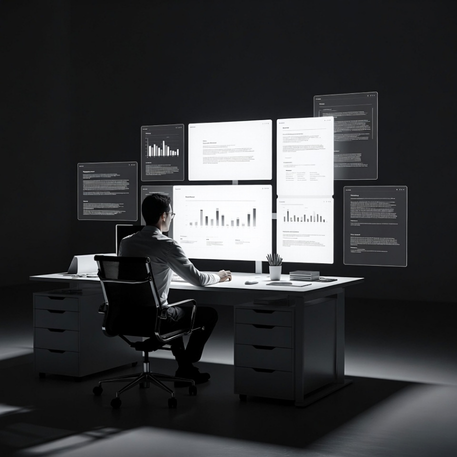
Why the next generation of software won't have a static UI, but one that evolves with your daily habits and workflow requirements.
Every major shift in computing has been accompanied by a corresponding shift in how we think about workspace. The terminal gave way to the graphical desktop. The desktop gave way to the browser. The browser is now giving way to something we're only beginning to understand: the generative workspace.
What Makes a Workspace "Generative"?
A generative workspace is one that actively participates in the user's creative and productive process — not just as a neutral container, but as an adaptive collaborator. Its structure, tools, and information density reconfigure in response to what the user is trying to accomplish.
In practical terms, this means interfaces that:
- Surface relevant tools contextually, rather than requiring users to navigate static menus
- Remember and apply preferences learned from past behavior without explicit configuration
- Adapt information density based on task complexity and cognitive load signals
- Generate novel interface components on demand when standard tools are insufficient
The End of One-Size-Fits-All Software
The software industry has long operated on a fundamentally flawed assumption: that a single interface design can serve all users equally well. The generative workspace model rejects this entirely. Each user's workspace becomes, over time, a bespoke instrument — tuned to their specific workflow, vocabulary, and cognitive style.
The Design Challenge
Building generative workspaces requires rethinking the entire design process. Instead of designing fixed layouts, designers must author systems of constraints and behaviors — guardrails within which the interface can safely evolve.